

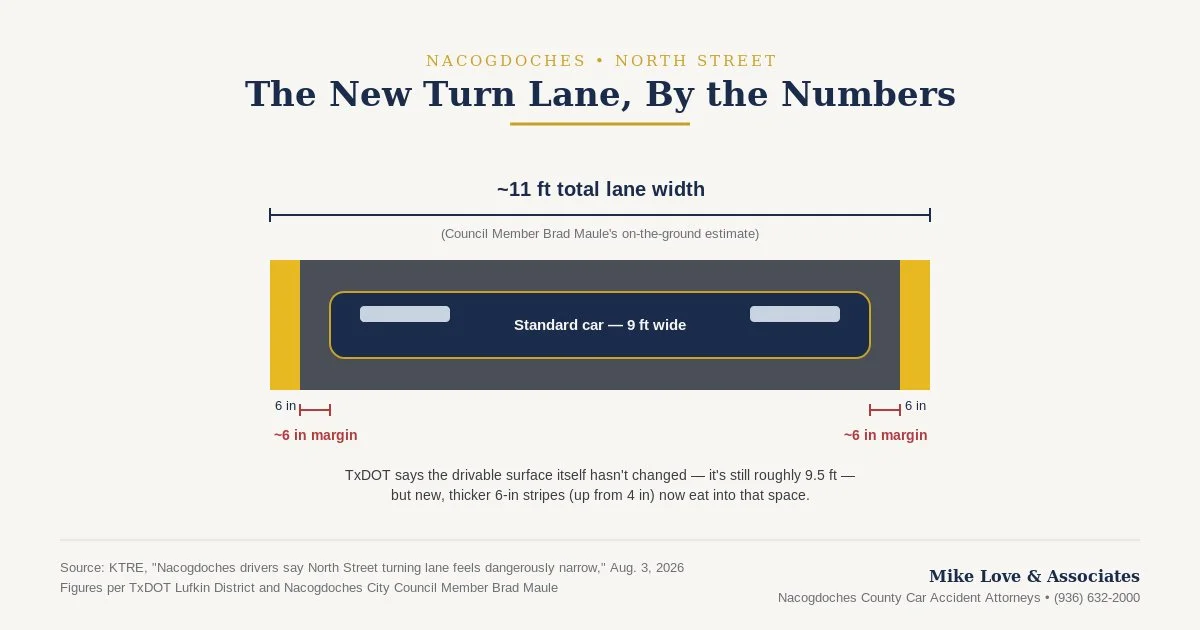
What the New North Street Turning Lane Means for Nacogdoches Drivers
TxDOT repaved and re-striped North Street in Nacogdoches, and drivers say the turning lane now feels dangerously narrow. Here's what changed, what TxDOT says, and what it means if you drive this stretch.
If you drive North Street in Nacogdoches, you've probably noticed something feels different since TxDOT repaved the road earlier this year. According to a report from KTRE, several drivers — including City Council Member Brad Maule, who represents the Northwest Ward — say the newly re-striped turning lane feels uncomfortably tight, with vehicles passing just inches apart.
What Changed
TxDOT's Lufkin District says the North Street project was a routine mill-and-inlay repaving, which required the road to be re-striped afterward. The new striping uses six-inch-wide lines, TxDOT's current standard for pavement markings — two inches wider than what was there before.
According to TxDOT Public Information Officer Tim Monzingo, the actual drivable surface hasn't gotten narrower. The lane is still roughly nine-and-a-half feet wide, the same as before the repaving. But the thicker lines eat into the usable space, which can make the lane feel — and in practice function — tighter than it did previously.
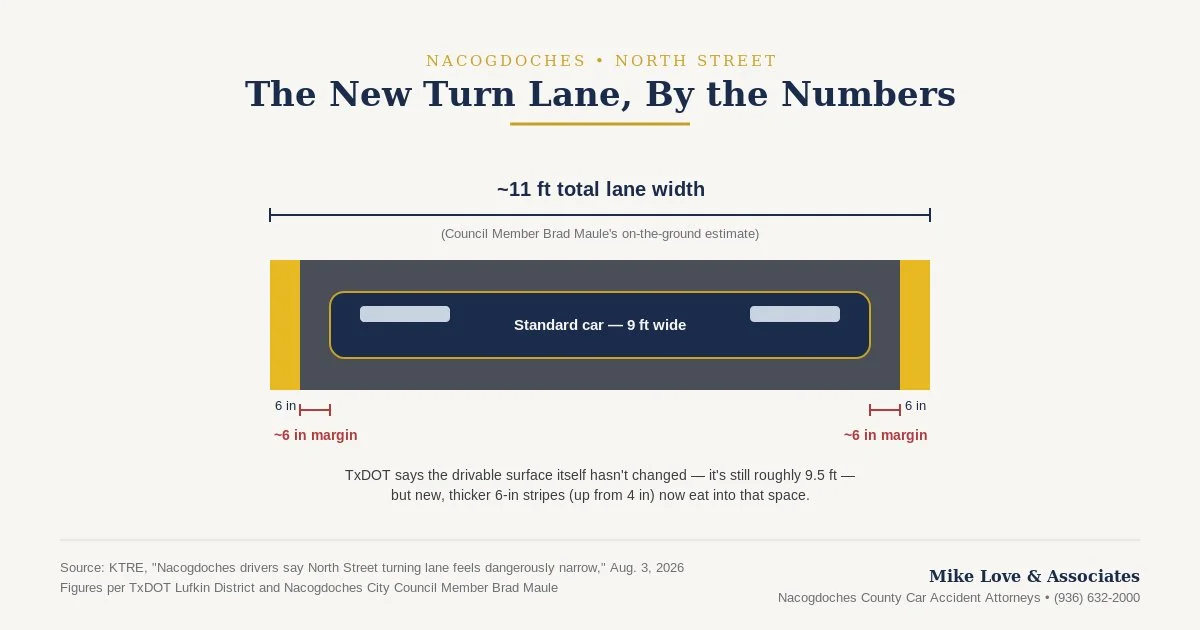
By the numbers: Council Member Brad Maule's estimate of the North Street turn lane leaves roughly 6 inches of margin on each side of a standard car. TxDOT says the drivable surface hasn't changed — only the stripe width has.
Why Drivers Are Concerned
Council Member Maule estimates the lane at about 11 feet wide including the markings. With a standard car measuring roughly nine feet across and six inches of yellow line on either side, there's very little margin for error — especially for the work trucks and larger vehicles common among his ward's residents.
"We're afraid somebody's going to get killed on this," Maule told KTRE, noting that many drivers in the area are plumbers, welders, and tradespeople who depend on larger trucks to carry tools and equipment for work.
What the Data Shows
TxDOT points to crash numbers as evidence the repaving has helped, not hurt. Along the stretch of North Street from the North Loop to Pillar Street, crashes dropped from 65 between January and July 2025 to 46 over the same period in 2026 — a meaningful reduction. TxDOT says it will continue monitoring the road, though it has no current plans to change the striping.
What This Means If You Drive This Stretch
Whether the narrower feel is an optical illusion or a real reduction in margin, the practical advice for drivers is the same: slow down through this section, give extra space when passing or being passed in the turning lane, and be especially cautious if you're driving a larger vehicle. Perceived risk changes driving behavior, and until drivers adjust to the new markings, this stretch deserves extra attention.
If You're Involved in a Wreck on North Street
Road conditions, striping, and construction changes are exactly the kind of details that matter after a crash — and they're often overlooked in the first confusing hours after a wreck.
"Any time a road changes, drivers need time to adjust — and until they do, that stretch carries more risk," said Mike Love, founding attorney of Mike Love & Associates. “If you’re involved in an accident on North Street, try to document the circumstances as best you can with photos or video, but you need to do so with extreme caution, and only when first responders have arrived to shut down traffic to prevent additional accidents. Also, if you are injured, take care of yourself or anyone else injured first. Let the police collect the evidence if you are hurt.”
Mike Love & Associates represents injured drivers throughout Nacogdoches, Angelina, Polk, and Houston counties. If you've been hurt in a car accident, call (936) 632-2000 for a free consultation.
Should Distracted Driving Laws in Texas Be Decentralized?
Discover when amusement parks are responsible for injuries, including causes like poor maintenance and defective equipment. Contact us for legal guidance.
Texas recently became the 47th state in the country to pass a statewide texting-and-driving ban. Before the passage of House Bill 62 (HB 62), also known as the Alex Brown Memorial Act, Texas law prohibited drivers under 18 from using wireless communication devices. In addition, drivers could not use mobile phones in school zones or if they possessed a learner’s permit that was less than six months old. HB 62 bans motorists from reading, writing, or sending electronic messages, regardless of their age or location. The law does not address making or receiving phone calls.
There are exceptions to texting under HB 62, such as reporting or responding to an emergency. Once the new law takes effect, first-time offenders could be fined up to $99 for texting and driving. Repeat offenders could be fined up to $200.When Governor Greg Abbott signed HB 62 into law at the end of the legislative session, he requested that cities and towns be banned from passing these ordinances. Instead, Senate Bill 15 would make the Alex Brown Memorial Act a uniform state law. Local ordinances would be rolled back. During the special legislative session, the Texas Senate signaled it would move ahead with the request. For many years, cities and towns across our state passed their own texting-and-driving ordinances.
As of 2016, 102 cities and towns had these ordinances. For example, in Nacogdoches, it is illegal to use any electronic messaging device while driving in city limits. In Conroe, you cannot text behind the wheel even if you are stopped on the side of the road. Austin, Texas, has an ordinance that bans the use of handheld electronic devices while operating a vehicle or a bicycle. However, you can use a hands-free device (Bluetooth or GPS) while driving or cycling in Austin. According to the Austin Police Department, this hands-free ordinance has led to a 17 percent reduction in fatal car accidents.
Are There Proponents and Opponents to Texas’ Distracted Driving Law?
Understandably, some opponents argue that centralizing distracted driving laws could lead to more deaths on Texas roads. Opponents say that municipal ordinances may be stricter than HB 62. Many of these opponents are law enforcement officials from across the state. There is some truth to this argument, as some cities and towns have hands-free ordinances.HB 62 does pass a statewide ban, meaning areas of Texas that did not have a ban on texting and driving will now have one. Before HB 62 passed, Lufkin did not have a distracted driving ordinance. Distracted driving is responsible for thousands of fatal car accidents per year in the United States. People who survive these accidents may suffer catastrophic injuries that can ruin not only their lives but the lives of their family members. Texting behind the wheel is an incredibly selfish act that puts other people at risk of being harmed. Injured in a car accident? Contact the Texas car accident lawyers at Mike Love & Associates, LLC. We are dedicated to making our community a safer place.
We want to hear your story.
Your consultation will always be with an experienced trial attorney. We are here to listen.