

Two 18-Wheelers Collide on US-59 South of Diboll After Illegal U-Turn
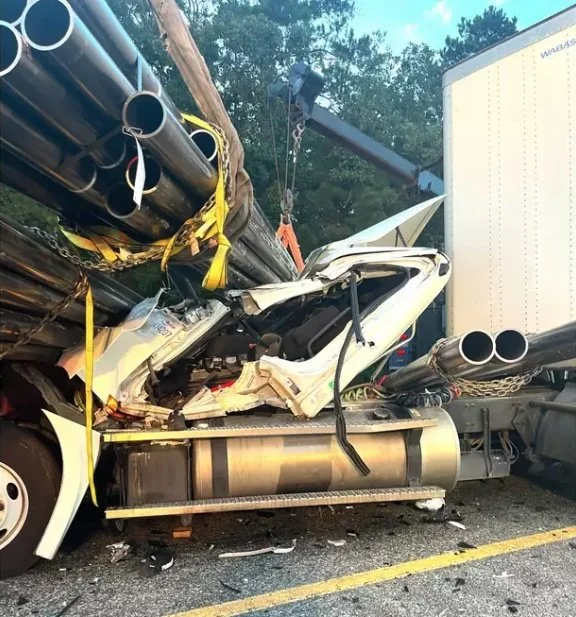
Photo Credit: Lufkin Fire Department
Early Wednesday morning, August 19, a serious collision between two commercial trucks shut down a stretch of US Highway 59 south of Diboll in Polk County. According to authorities, a 1991 International truck towing a flatbed trailer attempted a U-turn across a marked yield sign and pulled directly into the path of a northbound 2024 Freightliner tractor-trailer. The two vehicles collided at approximately 4:21 a.m.
The Freightliner's driver, Adoloph Ross of Elm Grove, Louisiana, was trapped in a badly crushed cab. It took Lufkin Fire Department's special operations team roughly 90 minutes to free him, with mutual aid from Diboll VFD, Livingston VFD, Corrigan VFD, Allegiance EMS, Texas DPS, and TxDOT. Assistant Fire Chief Ryan Watson described the extraction as delicate work, done carefully so first responders could free Ross without causing him further injury. Ross was flown by medical helicopter to a hospital in Houston with injuries that were not considered life-threatening.
Mike Love, founding partner at Mike Love & Associates, stated, "I owned and operated a trucking company for years before I ever went to law school, so I know exactly what a driver is supposed to see and do at a yield sign like this one. A loaded truck doesn't stop as a car does. When someone misjudges that gap, the consequences are severe, and that's exactly what we saw happen here."
How Fault Gets Determined in a Truck-on-Truck Collision
Most people picture an 18-wheeler wreck as a big rig against a passenger car. This one was two commercial trucks, and that distinction matters. When both vehicles involved are governed by commercial driving rules, there are more layers of evidence, more parties who could be held responsible, and more that can disappear if it isn't secured quickly.
A yield sign violation like the one reported here is usually one of the more straightforward liability findings under Texas traffic law: the vehicle required to yield is responsible for ensuring the way is clear before proceeding. But "usually straightforward" doesn't mean automatic. In a commercial truck case, that initial police determination is just the starting point. Insurance carriers and defense attorneys for trucking companies routinely dispute how a wreck happened, and they move fast to do it.
That's why the first 24 to 48 hours after a commercial truck wreck matter so much. Modern trucks, including flatbed rigs like the one involved in this crash, are typically equipped with an Engine Control Module and telematics data that record speed, braking, and location in the moments before a collision. Dashcam footage, weigh station records, driver logs, and maintenance records can all be relevant, and much of it is only preserved if someone moves to request it before it's routinely overwritten or discarded. Skid marks and debris fields get cleared from the roadway within hours. Witnesses who saw the crash from nearby vehicles are hardest to track down the longer it's been.
Why This Case Is Different From an Ordinary Fender-Bender
Commercial vehicles operate under federal motor carrier regulations that don't apply to ordinary drivers — rules covering hours of service, cargo securement, vehicle maintenance, and driver qualification. When a commercial truck is involved in a wreck, whether or not it's carrying a load at the time, those regulations can open up additional questions about whether the truck, the trailer, or the company behind either one was in compliance leading up to the crash. A yield violation might be the immediate cause listed in a police report, but it's rarely the whole story once all the records are pulled.
What East Texas Drivers Should Take From This
US-59 between Lufkin, Diboll, Corrigan, and Livingston carries a heavy mix of commercial and passenger traffic every day, and during low-visibility hours like early morning, driver fatigue and misjudged gaps in traffic are most likely to turn a routine maneuver into a serious wreck. Yield signs exist because that stretch of highway asks drivers merging or turning to accurately judge the speed and distance of oncoming trucks, which can weigh 20 times as much as a passenger vehicle and take far longer to stop. When that judgment call goes wrong, the outcome is rarely minor.
If you or someone you know is ever involved in a wreck with a commercial truck in Angelina, Nacogdoches, Polk, or Houston County, the most important early steps are the same ones investigators rely on: get medical attention first, then get the physical evidence — vehicle data, photos, witness contact information — secured before it disappears. An attorney who understands the trucking industry from the inside, not just from the outside looking in, can move quickly to request and preserve that evidence while it still exists.
About Mike Love & Associates
Mike Love spent years running his own trucking company, which means he doesn't have to guess at how a fleet operates, what a driver's logbook is supposed to show, or what a yield sign violation really means for who's at fault. That background shapes how Mike Love & Associates approaches every commercial vehicle case: from the inside of the industry, not just the outside of a courtroom.
If you've been injured in a truck accident anywhere in Angelina, Nacogdoches, Polk, or Houston County, contact Mike Love & Associates for a free consultation to discuss your case and your options.
